


21 Sep What Could New Zealand’s Election Mean for Property Investors, Developers and Borrowers
How New Zealand’s Election Could Impact Property Investors, Developers and Borrowers
New Zealand elections often bring uncertainty, particularly for the property market. Buyers become more cautious, investors wait to see what policy changes may be introduced, and developers sometimes delay projects until there is greater clarity. While political headlines can dominate the news cycle, the fundamentals that drive property values and lending decisions generally remain the same. Interest rates, inflation, employment, construction costs, population growth and access to finance continue to have the greatest influence on the market over the long term.
For property investors, developers and business owners, understanding what may change after an election can help them make informed decisions rather than reacting purely to speculation. Whether a project is already underway or still in the planning stages, having the right finance strategy in place can make all the difference. This article explores how elections have historically influenced New Zealand’s property market, what borrowers should watch over the coming months, and why opportunities often continue to exist regardless of which party forms the next Government. Throughout the article, we’ll also look at how experienced lenders can help borrowers navigate periods of political and economic uncertainty.
Why Elections Create Uncertainty in Property Markets
Why Buyers and Investors Often Pause Before an Election
Every New Zealand election introduces an element of uncertainty into the economy, and the property market is often one of the first sectors to feel its effects. While election campaigns focus on competing policies around taxation, housing affordability, infrastructure spending and economic management, buyers and investors are frequently left wondering whether it is better to proceed with their plans or wait until the political landscape becomes clearer. This hesitation is understandable, particularly when media coverage focuses heavily on opinion polls and predictions rather than the underlying strength of the economy. As confidence softens, transaction volumes often decline, not necessarily because opportunities have disappeared, but because many purchasers prefer to delay making significant financial commitments until they know what the next Government will look like.
Despite this temporary slowdown, quality opportunities continue to exist throughout every election cycle. Vendors still need to sell, developers continue building, and businesses still require funding to grow. For experienced investors, periods of uncertainty can often create favourable buying conditions as competition reduces and motivated sellers become more willing to negotiate. Having access to flexible property finance means borrowers can move quickly when opportunities arise instead of waiting for headlines to settle. While every investor’s circumstances are different, history has repeatedly shown that property markets generally reward those who focus on long-term fundamentals rather than allowing short-term political uncertainty to determine every investment decision.
Politics May Influence Confidence, but Market Fundamentals Drive Performance
Election campaigns can have a significant influence on confidence, but confidence alone rarely determines the long-term direction of New Zealand’s property market. The factors that continue to shape property values year after year are largely economic rather than political. Interest rates, inflation, employment, migration, construction costs, housing supply and population growth all play far greater roles in determining market performance than a single election result. Governments can certainly introduce policies that influence investment behaviour, however those changes typically take time to filter through the economy and rarely alter the underlying demand for quality residential and commercial property overnight.
The same principle applies when lenders assess finance applications. Whether funding is being sought for a commercial acquisition, residential development or investment purchase, lenders remain focused on the strength of the proposal itself. Security, available equity, borrower experience, servicing ability and a realistic exit strategy remain the key considerations throughout the lending process. Borrowers who have taken the time to prepare their application thoroughly are often well positioned regardless of the political environment. Those considering future projects should continue evaluating opportunities based on sound financial principles rather than speculation, particularly if they are planning a property development where preparation and timing remain critical to achieving a successful outcome.
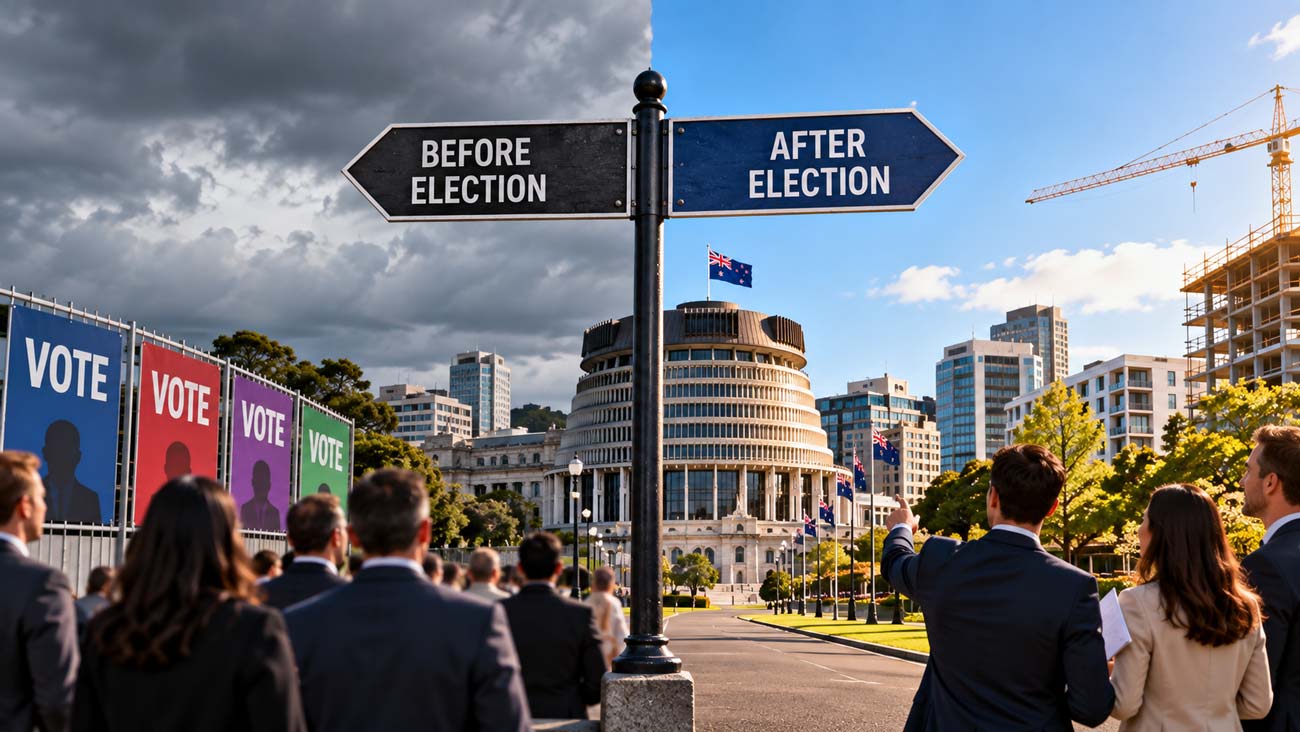
What Usually Happens Before and After a New Zealand Election?
Election Cycles Often Create Short-Term Market Hesitation
One of the more consistent trends observed during New Zealand election years is a temporary slowdown in market activity as buyers, investors and developers adopt a cautious approach. This doesn’t necessarily mean the market is weakening. Rather, uncertainty causes many people to postpone major financial decisions until they have a clearer understanding of the political landscape and any policy changes that may affect taxation, lending, housing or business investment. Residential buyers may delay purchasing their next home, investors often hold back on acquiring additional properties, and developers sometimes postpone new projects until confidence returns. This reduction in activity can create the impression that the property market is struggling, when in reality many participants are simply waiting for greater certainty.
The interesting aspect of this behaviour is that opportunities rarely disappear during election periods. Vendors still need to sell, businesses continue operating, and development projects still require funding to move forward. For borrowers who have already completed their due diligence and secured funding, quieter markets can actually provide advantages through reduced competition and increased negotiating power. Investors who understand market cycles often recognise that periods of uncertainty can present opportunities that are not always available during stronger market conditions. Those considering buying an investment property should continue assessing opportunities based on location, cash flow, long-term growth potential and finance availability rather than allowing election headlines alone to dictate their investment strategy.
Confidence Typically Returns Once the Election Is Over
Once election results are confirmed, one of the biggest benefits for the market is the return of certainty. Regardless of which political party forms the next Government, buyers, investors and businesses are then able to make decisions based on known policies instead of campaign promises and media speculation. Markets generally respond positively to certainty because it allows businesses to prepare, investors to evaluate opportunities more accurately and lenders to continue supporting quality transactions with greater confidence. While policy changes may influence particular sectors over time, the immediate removal of uncertainty often encourages activity that had been delayed during the campaign period.
Experienced property investors understand that successful investing is measured over decades rather than election cycles. Political leadership will inevitably change multiple times throughout the life of any property investment, yet the underlying drivers of long-term wealth creation remain remarkably consistent. Population growth, infrastructure investment, employment, rental demand and responsible borrowing continue to influence returns long after election campaigns have ended. Investors who maintain a disciplined financial strategy and have access to appropriate funding are generally better positioned to take advantage of opportunities whenever they arise. Whether acquiring commercial property or expanding an existing portfolio, working with specialists who understand commercial property finance can help borrowers structure funding that supports both their immediate objectives and their longer-term investment goals.
The Policies Property Investors Will Be Watching
Tax, Housing and Lending Policies Will Remain Under the Spotlight
Every election brings renewed discussion around taxation, housing affordability and property investment, making these some of the most closely watched policy areas for investors and developers. While individual parties may propose different approaches to encouraging home ownership, increasing housing supply or adjusting tax settings, the overall impact of these changes often takes years rather than months to become fully apparent. Investors should therefore avoid making significant financial decisions based solely on campaign announcements. Instead, they should consider how any future policy changes may influence the long-term performance of their portfolio rather than expecting immediate market shifts once a new Government is formed.
Tax deductibility, capital gains discussions, infrastructure spending and planning reforms have all featured prominently in previous election campaigns, and these issues continue to influence investor confidence today. However, regardless of which policies eventually become law, the fundamentals of successful property investment remain unchanged. Purchasing quality assets in desirable locations, maintaining sufficient equity, managing cash flow carefully and securing appropriate funding continue to be the foundations of long-term success. Investors who take a disciplined approach are generally better positioned to adapt as legislation evolves. For borrowers looking to expand their portfolio, understanding the available property investment financing options before making their next purchase can provide greater flexibility when market conditions change.
Infrastructure Investment Could Shape Future Growth Areas
One area that often receives less attention than taxation is Government investment in infrastructure. Roads, public transport, water services, schools, hospitals and major commercial developments can all have a significant influence on future property demand. Regions that receive substantial infrastructure funding frequently experience increased business activity, stronger population growth and greater demand for both residential and commercial property over time. While major projects can take years to complete, experienced investors often begin identifying opportunities well before construction starts.
Property developers are particularly aware of the importance of infrastructure planning when assessing future projects. Access to transport links, utility services and growing communities can have a direct impact on the viability and profitability of a development. Election outcomes may influence the timing and prioritisation of infrastructure spending, but successful developments are still built around careful research, sound financial planning and realistic market demand. Those considering larger projects should ensure they have appropriate funding in place before opportunities arise. Working with experienced lenders who understand commercial property development can provide developers with the flexibility needed to respond quickly when suitable sites become available, regardless of the political environment.
Will Banks and Non-Bank Lenders Change Their Lending?
Quality Borrowers Continue to Secure Funding
One question many borrowers ask during an election year is whether banks and non-bank lenders will tighten their lending criteria while waiting for the political landscape to settle. In reality, lending decisions are rarely based on election outcomes alone. Financial institutions are primarily concerned with managing risk, assessing serviceability, evaluating security and ensuring borrowers have realistic exit strategies. These lending fundamentals remain largely unchanged regardless of which political party forms Government.
Where elections can have an indirect influence is through confidence. Some borrowers postpone applications, while lenders may take a slightly more measured approach to sectors experiencing short-term uncertainty. However, well-prepared borrowers with quality security, sensible leverage and a clear purpose for the funding continue to receive finance throughout election periods. Investors who already have suitable opportunities identified often find that obtaining approval before market activity accelerates again can place them in a stronger competitive position.
This is one reason why many experienced investors work with lenders who understand complex transactions rather than relying solely on traditional bank lending. Access to flexible funding solutions can allow borrowers to move quickly when opportunities arise, particularly where timing is critical. Borrowers who have previously struggled to meet conventional lending criteria may also benefit from exploring non-bank property investment loans, which are often designed to provide greater flexibility for experienced investors and developers.
Why Flexible Lending Can Create Opportunities
Election periods often create opportunities that simply don’t exist when markets are moving quickly. Some property owners need to sell regardless of political uncertainty, developers may require funding to complete projects already underway, and businesses continue to invest for future growth. Having access to funding that can be arranged efficiently allows borrowers to respond when these opportunities become available instead of watching them pass by while waiting for lengthy approval processes.
Flexible lending has become an increasingly important part of New Zealand’s finance market, particularly for borrowers whose circumstances don’t fit traditional bank policies. Development projects, commercial acquisitions, bridging finance and complex investment structures often require lenders who are prepared to assess the overall strength of the transaction rather than relying solely on automated lending models. This broader approach can be particularly valuable during periods when market sentiment is cautious.
Rather than focusing on short-term political headlines, successful borrowers continue preparing finance well in advance. Having lending pre-approved, understanding available equity and working with experienced finance specialists provides confidence regardless of market conditions. Whether funding a commercial acquisition or a new development project, the ability to access appropriate finance often becomes the deciding factor between securing an opportunity or missing it altogether.

Should Investors Wait Until After the Election?
Waiting Can Sometimes Mean Missing Opportunities
Many investors naturally assume that waiting until after an election is the safest course of action. While this approach may provide greater certainty around Government policy, it can also result in missed opportunities. Property markets do not simply pause until political events conclude. Vendors continue to sell, developers continue building and quality investment opportunities continue to become available. In some cases, reduced competition during election campaigns may even allow buyers to negotiate more favourable purchase prices or terms than they would encounter in a stronger market.
Successful investors generally avoid making decisions based purely on short-term uncertainty. Instead, they assess each opportunity on its own merits, considering factors such as location, rental demand, future growth potential, available equity and financing costs. These are the same principles that apply regardless of whether an election is weeks away or several years in the future. Political cycles come and go, but well-selected property assets often continue delivering value over many years.
Borrowers who already have finance arranged are frequently in a stronger negotiating position than those who decide to wait. Understanding how to increase available funding before opportunities arise can make a significant difference, particularly in competitive markets. Strategies such as those discussed in how to increase your borrowing power can help investors position themselves for future acquisitions regardless of election outcomes.
Focus on Long-Term Financial Strategy Rather Than Headlines
Property investment has always been a long-term wealth-building strategy. Investors who achieve consistent success are generally those who remain disciplined, continue researching opportunities and avoid making emotional decisions based on short-term news cycles. Elections generate considerable media attention, but they represent only a brief period within the life of an investment that may be held for ten, twenty or even thirty years.
A strong financial strategy considers much more than politics. Interest rates, debt management, portfolio diversification, cash flow and access to funding all contribute to long-term success. Investors who regularly review their borrowing structure and ensure they have sufficient flexibility are often better equipped to respond as markets evolve. They can take advantage of opportunities during quieter periods while also remaining prepared for stronger market conditions in the years ahead.
Rather than attempting to predict political outcomes, experienced borrowers typically focus on ensuring they have appropriate finance in place, quality assets under consideration and realistic long-term objectives. This disciplined approach has consistently proven more valuable than attempting to time the market around individual election cycles.
How Global Pacific Capital Can Help During Uncertain Times
Funding Solutions Designed Around Your Objectives
Periods of political and economic uncertainty often highlight the importance of working with experienced finance specialists who understand that every borrowing requirement is different. While some borrowers are purchasing investment properties, others may be undertaking commercial developments, refinancing existing debt or requiring short-term funding to complete a transaction. No two situations are identical, which is why tailored finance solutions often deliver better outcomes than a one-size-fits-all lending approach.
Global Pacific Capital works with a broad range of funding partners to help borrowers access solutions that align with their objectives rather than forcing transactions into rigid lending criteria. Whether funding is required for residential development, commercial acquisitions, land banking or business expansion, understanding the available options can often open opportunities that may not be available through traditional lending channels alone.
For borrowers planning future projects, reviewing finance options before making an offer can significantly improve both confidence and negotiating power. Having access to experienced advice allows investors and developers to move quickly when suitable opportunities arise, regardless of broader market sentiment.
Looking Beyond the Election and Towards Long-Term Success
While election results inevitably influence public discussion, successful property investing and development has always been about taking a long-term view. Governments will change, economic cycles will continue and interest rates will move over time, but quality property backed by sound financial planning remains one of the most effective ways to build wealth over the longer term.
Preparing early, maintaining sufficient equity and securing appropriate finance allows borrowers to make informed decisions based on opportunity rather than uncertainty. Whether you are purchasing your next investment property, undertaking a development project or restructuring existing borrowing, having the right lending strategy can make a significant difference to your long-term financial success.
If you are considering your next property investment, development or commercial finance requirement, Global Pacific Capital can help you explore funding solutions that match your objectives. From traditional lending through to specialist funding structures, our team can assist borrowers in navigating changing market conditions with confidence. Learn more about our flexible approach to business mortgage finance or contact our team to discuss your next opportunity.
Conclusion
Every New Zealand election brings a degree of uncertainty, and it is natural for buyers, investors and developers to question whether it is the right time to move forward with their plans. While political debate often dominates the headlines in the weeks leading up to polling day, history suggests that property markets continue to be driven by much broader economic fundamentals. Interest rates, inflation, employment, population growth, infrastructure investment and access to finance will continue to shape the market long after the election result is known.
Rather than attempting to predict political outcomes, successful investors typically focus on preparing themselves for opportunities whenever they arise. Having a clear investment strategy, understanding available finance options and working with experienced lending specialists can provide a significant advantage during both uncertain and buoyant market conditions. Elections may influence confidence for a period, but well-planned property investments are generally measured over decades rather than months.
Whether you’re purchasing your first investment property, expanding a commercial portfolio, undertaking a residential development or refinancing an existing loan, obtaining the right funding structure remains one of the most important decisions you’ll make. Taking the time to review your borrowing strategy before opportunities arise allows you to act with confidence when the right property becomes available.
At Global Pacific Capital, we work with investors, developers and business owners throughout New Zealand to source lending solutions that suit their individual objectives. If you’d like to discuss your next property purchase, development project or commercial finance requirement, our experienced team is ready to help you explore flexible funding options and develop a lending strategy that supports your long-term goals.
FAQs
Will the New Zealand election affect property prices immediately?
In most cases, elections create short-term uncertainty rather than immediate changes in property prices. Market activity may slow while buyers and investors wait for greater clarity, but long-term property values are generally influenced more by interest rates, economic growth, housing supply and population trends.
Should I wait until after the election to buy an investment property?
Every investor’s situation is different. While some buyers prefer to wait for policy certainty, others see quieter markets as an opportunity to negotiate favourable purchases. The best approach is to assess the quality of the investment, your financial position and your long-term objectives rather than relying solely on election timing.
Will lenders become more restrictive during an election period?
Banks and non-bank lenders generally continue assessing applications based on standard lending criteria, including security, equity, servicing ability and exit strategy. Well-prepared borrowers with quality proposals can often continue securing finance regardless of political uncertainty.
Can property developers still obtain finance during election periods?
Yes. Development projects continue throughout election cycles, provided they meet lender requirements. Experienced developers with strong projects, realistic feasibility studies and appropriate equity are often able to secure funding from both banks and specialist lenders.
Why work with a non-bank lender?
Non-bank lenders can often provide greater flexibility for borrowers whose circumstances fall outside traditional bank lending policies. They may be particularly suitable for development finance, commercial lending, bridging finance and more complex property transactions where speed and flexibility are important.